
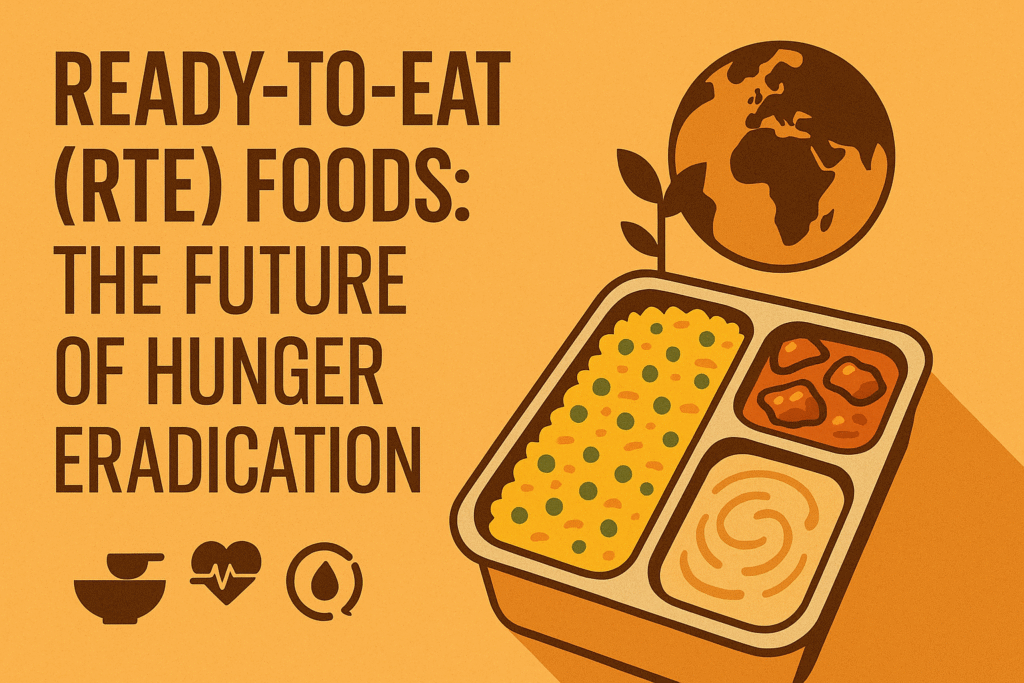
In a world that is advancing rapidly in technology, yet still grappling with the age-old challenge of hunger, Ready-to-Eat (RTE) foods are emerging as a game-changer. These shelf-stable, nutritionally rich, and easy-to-distribute food solutions are proving to be powerful tools in fighting food insecurity, especially in under served and disaster-prone regions.
🌍 The Global Hunger Crisis
According to the UN Food and Agriculture Organization (FAO), over 735 million people faced hunger in 2023. The situation is exacerbated by climate change, conflict, inflation, and lack of access to nutritious food. Traditional food systems are struggling to keep up with growing demands and shrinking resources.
✅ Why RTE Products Are a Game-Changer
RTE products refer to meals that are fully cooked, hygienically packaged, and require little to no preparation. These products are not just a convenience for urban consumers but a lifesaving innovation for food-insecure populations.
Key Benefits:
- Long Shelf Life: Most RTE products can be stored for 6 months to a year without refrigeration.
- Nutrition-Packed: Formulated to meet caloric and micro nutrient needs.
- Portability: Ideal for disaster relief, school feeding programs, and rural outreach.
- Minimal Waste: Precise portions reduce food spoilage and wastage.
- Quick Distribution: Perfect for rapid deployment in emergencies or remote villages.
🌱 RTE Products & Sustainable Development Goals (SDGs)
RTE meals directly contribute to:
- SDG 2: Zero Hunger
- SDG 3: Good Health and Well-Being
- SDG 12: Responsible Consumption and Production
When produced using local ingredients and community-based micro-enterprises or FPOs, RTE foods also support livelihood generation, ensuring a sustainable food economy.
🍛 India’s Role in Scaling RTE for Social Impact
India, with its rich culinary diversity and large agricultural base, is uniquely positioned to lead the RTE revolution. Innovative companies and social startups are now:
- Developing millet-based, traditional, and tribal RTE items.
- Collaborating with Farmer Producer Organizations (FPOs).
- Supporting anganwadi centers and midday meal schemes with fortified RTE packs.
At Agribite Soil to Serve Pvt. Ltd., we believe in transforming indigenous wisdom into modern nutrition. Our platform is building a bridge between rural producers and national markets through safe, hygienic, and nutritious RTE products—from laddus to vermicelli, chatua to ready millet khichdi.
🚀 The Road Ahead: From Relief to Resilience
The goal is not just to provide food during emergencies but to build food resilience. RTE products are a scalable way to:
- Ensure no child sleeps hungry.
- Provide nutrition to expecting mothers and elderly.
- Empower rural women in food processing and entrepreneurship.
When backed by government policy, private investment, and community participation, RTE products can reshape the future of food security.
🤝 Conclusion: A Ready Future
Hunger is not a result of food scarcity but of distribution and access gaps. Ready-to-Eat foods offer a practical, scalable, and sustainable way to bridge those gaps. They represent more than convenience—they represent compassion, innovation, and empowerment.
Let’s invest in RTE not just as a product category, but as a mission for nourishment, dignity, and equity.